Walk or Bike the Old Seven Mile Bridge to Pigeon Key – Marathon’s Most Iconic Adventure
There is a moment, about halfway across the Old Seven Mile Bridge, when you realize the full scale of what surrounds you. Open ocean stretches in every direction. The Florida Keys shimmer in the distance. The wind off the Gulf carries the faint smell of salt and possibility. And beneath your feet, a structure that changed the world — or at least the southernmost stretch of it — hums with more than a century of American history. Walking or biking the Old Seven Mile Bridge to Pigeon Key in Marathon is one of the most exhilarating, beautiful, and historically rich experiences available anywhere in the Florida Keys.
Whether you are a casual walker, a dedicated cyclist, a history enthusiast, or simply someone chasing one of the most dramatic panoramic views in Florida, the bridge-to-Pigeon-Key experience delivers on every level. Here is your complete guide.
A Brief History of the Seven Mile Bridge
The original Seven Mile Bridge was built as part of Henry Flagler’s ambitious Florida Overseas Railway — a now-legendary engineering project that connected the Florida mainland to Key West by rail beginning in 1912. Flagler, already famous for developing much of the Florida East Coast, spent years and millions of dollars driving his railroad through the remote, hurricane-prone wilderness of the Keys. The railway was completed in 1912, and Flagler himself rode the inaugural train to Key West at the age of 82. He died the following year.
The Labor Day Hurricane of 1935, one of the most powerful Atlantic hurricanes ever recorded, destroyed much of the Overseas Railway and killed hundreds of workers and veterans who had been employed in the Keys as part of a federal work relief program. The railroad was never rebuilt. Instead, the existing rail bridges were converted into the Overseas Highway, and the former Seven Mile Bridge became a road that served traffic until 1982, when the new, wider concrete bridge was opened alongside it.
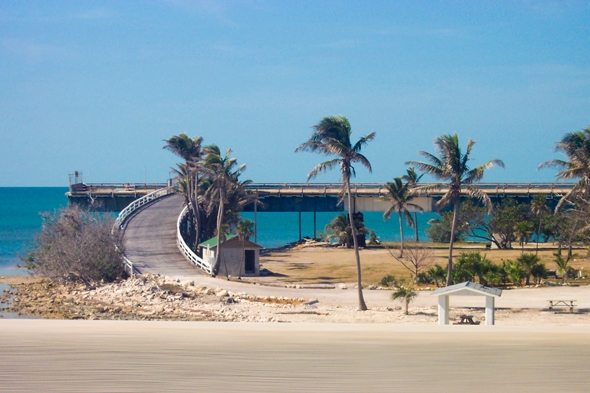
Today, the old bridge — officially closed to vehicle traffic — has been transformed into one of the longest pedestrian bridges in the world, offering walkers and cyclists a 2.2-mile pathway over open water with views that are simply without equal in Florida.
The Walk (or Ride) Across the Bridge
The pedestrian access point for the Old Seven Mile Bridge is located at the western end of Marathon, near the intersection of US-1 and the bridge approach. Parking is available in the small lot at the base of the bridge, and the entrance is clearly marked. The path is wide, flat, and fully open to the elements — which means you will want sunscreen, a hat, and water, particularly during summer months when the Florida sun is relentless.
The 2.2-mile walk to Pigeon Key takes approximately 45 minutes to an hour at a relaxed pace, though many visitors stop frequently to take in the views, photograph the water, or watch pelicans and frigate birds soar overhead. Cyclists can complete the journey in under 20 minutes and often make multiple passes. The bridge is wide enough to accommodate both pedestrians and cyclists comfortably, though the two should remain aware of one another.
As you walk, you will notice the new Seven Mile Bridge running parallel to the old one. The contrast is striking — the sleek modern roadway carrying a constant stream of traffic while you glide through silence and sea breeze on the century-old structure beside it. It is a genuinely moving experience, particularly for those who appreciate American infrastructure and history.
Best Time to Go: Early morning and late afternoon offer the most comfortable temperatures and the best light for photography. Sunrise walks on the bridge are spectacular and often uncrowded.
Pigeon Key: A National Historic District
At the end of the bridge sits Pigeon Key, a tiny five-acre island that served as the living and working quarters for the workers who built and maintained Henry Flagler’s Overseas Railway. At its peak, Pigeon Key housed more than 400 men who lived in a cluster of wooden structures that still stand on the island today. The island was added to the National Register of Historic Places in 1991 and is operated as a marine science and education center by the Pigeon Key Foundation.
Once you arrive on the island, you can explore the historic buildings on a self-guided tour, including the workers’ dormitories, the foreman’s house, the assistant bridge tender’s house, and the No Name hurricane house — so called because it was used as a refuge during hurricanes. Interpretive signs throughout the island explain the history of each structure and offer fascinating context about life on the railroad during the early twentieth century.
The island also features a small beach area, a gift shop, and a marine science education facility. Guided tours of Pigeon Key depart from the Marathon waterfront and include a ferry ride, making them an excellent option for those who do not wish to walk the bridge both ways.
Practical Information for Visiting the Old Seven Mile Bridge
Access Point: West end of Marathon near Mile Marker 47, Overseas Highway
Bridge Length: Approximately 2.2 miles (one way)
Activity: Walking, jogging, cycling, rollerblading
Cost: Free to access the bridge; ferry to Pigeon Key has a separate fee
Pigeon Key Website: pigeonkey.net
Best For: History lovers, photographers, families, cyclists
Heads Up: Bring your own water and sunscreen — there are no facilities on the bridge itself. Restrooms are available at the parking area and on Pigeon Key.
Why This Experience Belongs on Every Marathon Itinerary
The Old Seven Mile Bridge and Pigeon Key represent the Florida Keys at their most layered — natural beauty, human ambition, historical tragedy, and quiet resilience all compressed into 2.2 miles of open-air walkway. There is no admission fee, no crowds (by Florida standards), and no experience in the Keys quite like standing on that old bridge with the ocean in every direction and the wind at your back.
It is, by any measure, one of the best free things to do in Marathon, and one of the most memorable experiences available anywhere in the Florida Keys.